
When AI Helps
Early Wins in Supporting Economic Mobility

Editor’s note: This piece was co-written by SkillUp Coalition CEO Steven Lee, Upsolve CEO Jonathan Petts, and Upsolve CPO Claire Robinson. It was originally published on LinkedIn.
In our last piece, we shared how hard it is to build AI that actually works for low-income Americans navigating a job search or a bankruptcy filing. We shared the insecurities, missteps, and moments of doubt that come with building AI in high-stakes, real-world settings. This time, we want to focus on something different: what’s working.
Because despite the challenges, we’re starting to see real signs of progress. Over the past four months, both SkillUp and Upsolve have launched targeted AI-driven improvements—and the early results are encouraging.
SkillUp: AI That Keeps Job Seekers on Track
SkillUp helps low-income Americans explore new careers, enroll in training, and increase their earning power through a free digital platform. But like many digital tools, we struggle with drop-off before users reach the finish line: completing training, landing a job, and boosting income.
So we focused our AI strategy on three core questions where users often stall:
“What should I do?” to reduce analysis paralysis
“Should I move forward?” to build confidence
“What will I earn?” to clarify the payoff
We embedded personalized AI prompts directly into the user experience—nudging people at key decision points, instead of relying on a chatbot alone.
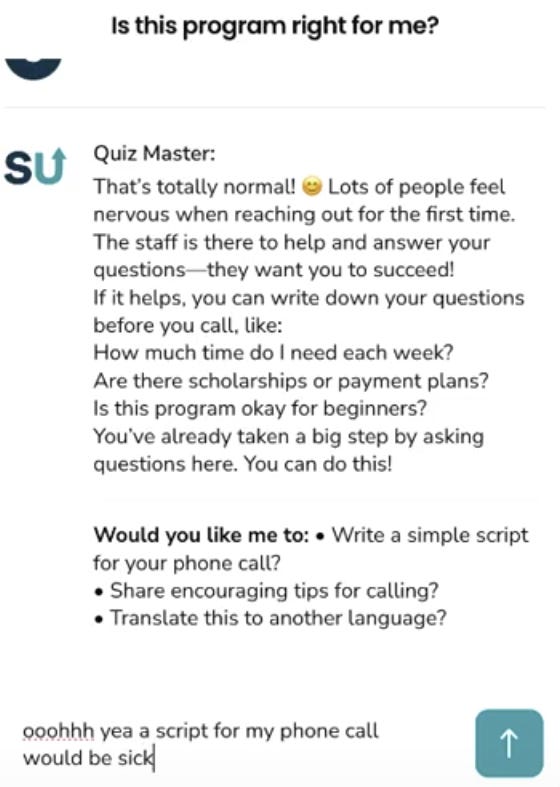
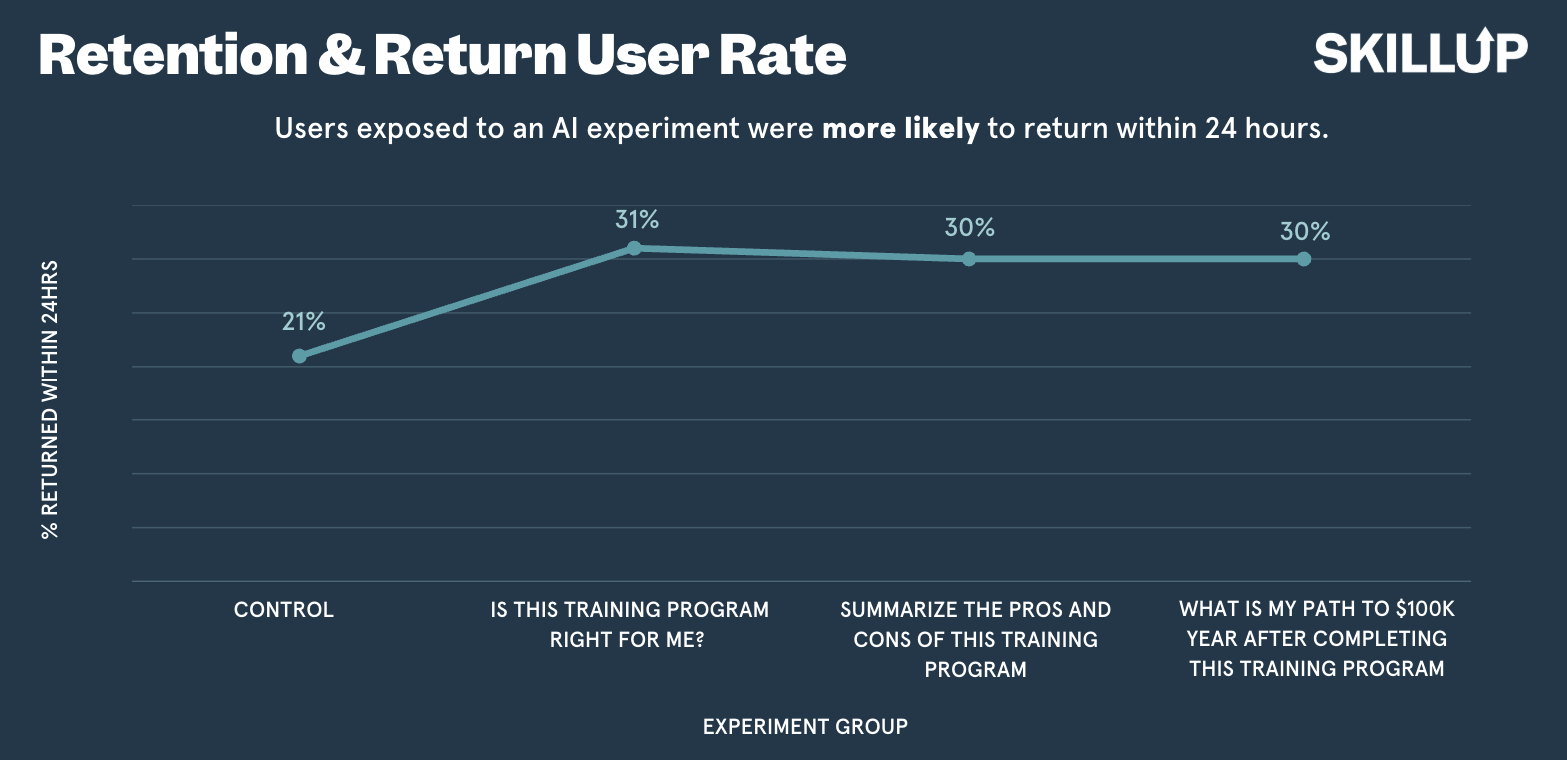
In a test with 1,500 users, we randomized three prompt types tied to each barrier above and compared outcomes to a control group. We tracked engagement metrics—like click-outs, saves, program views, return visits—and layered in demographic analysis to ensure equity.
The impact was clear:
Users who received AI prompts viewed 16–22% more training programs
They were ~50% more likely to return within 24 hours
From survey follow-up, we estimate these gains led to a 13% increase in job attainment and a 15% increase in average wages, translating to $342K in lifetime earnings across the 1,500-user test group directly attributable to SkillUp’s AI intervention (and extrapolated across all SkillUp users, over 6,500 additional jobs worth over $250M in lifetime earnings).
These early wins have given us conviction that further investments in AI can move the needle for low-income job-seekers on their journey to the middle-class.
Upsolve: AI Paralegal
At Upsolve, we help low-income Americans file for bankruptcy without a lawyer. Even with a simplified product, the process remains daunting—users often have dozens of questions along the way.
For years, we had just two full-time paralegals supporting tens of thousands of users annually. Many people were left waiting too long for help—or dropping off before completing their filing.
To close this gap, we turned to AI—not to replace human support, but to extend it, making personalized help instantly accessible at scale.
1. AI Has Become a Core Support Channel
In April, we launched an AI assistant inside the most complex part of our tool: the bankruptcy questionnaire. Available 24/7 and responding in under five seconds, it delivers tailored, conversational answers that go far beyond static help articles.
It’s now a foundational part of the experience: 59% of daily users interact with the chatbot.
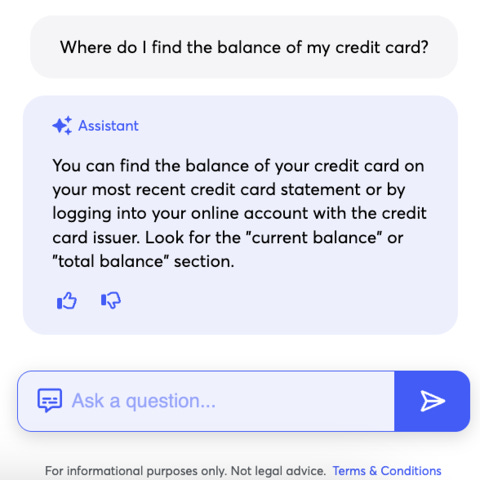
One breakthrough? We introduced tap-to-ask prompts—pre-filled questions surfaced at key points in the interview. Especially on mobile, reducing the need to type has helped keep users engaged and moving forward. The takeaway: less typing = less drop-off.
Behind the scenes, AI is also streamlining painful steps like users having to manually enter their income and deductions—a common barrier to completion. When users upload a pay stub, our system can now extract and auto-fill income and deduction data for the user’s review. Today, this automation covers 50% of uploads, with improvements underway to expand coverage.
2. AI Is Fueling Scalable, Life-Changing Impact
This year, Upsolve’s monthly bankruptcy filings have surged by 157%. Each completed filing represents a major financial reset—stopping garnishments, eliminating debt, and in many cases, preventing homelessness. On average, that translates to nearly $160,000 in lifetime net worth gained per user.
This level of impact wouldn’t be possible without our AI assistant, which has become essential to scaling support efficiently.
Since February, the number of people completing our screener has more than tripled—driven by more efficient marketing. Without the chatbot, our support system would have been overwhelmed.
Take last month as an example:
We had projected 877 Zendesk tickets (user questions) based on growth
We received only 457, thanks to the AI Assistant now answering many questions on demand
That’s 420 questions deflected in a month—nearly double last year’s monthly volume of 237.
The chatbot absorbed the surge, allowing our lean team to stay focused without compromising user experience.
In effect, our AI copilot acts as a virtual paralegal team, resolving issues in seconds that used to take hours or days. While conversion rates haven’t spiked, they’ve remained steady—a critical outcome as usage has surged. That kind of stability simply isn’t possible through human support alone.
Bottom line: AI is allowing us to serve more people with dignity, speed, and scale.
Looking Ahead: Building the Next Generation of AI for Economic Mobility
We’re encouraged by the early wins, but we know this is just the beginning. The potential of AI to improve economic outcomes is enormous, and the pace of innovation is accelerating. With the rise of agentic and multimodal systems, the opportunity is no longer just about answering questions—it’s about helping people take action and stay on track through complex, high-stakes journeys.
SkillUp, Upsolve, and our partner Climb Together were recently selected for the Google.org Generative AI Accelerator. Together, we’re working to build an AI-native, agentic experience for low-income Americans navigating job searches, social connections, and debt relief. These paths are full of friction points—places where users drop off and often don’t return.
To build tools that truly support these users, the next generation of AI for economic mobility should be guided by three core principles:
1. Build trust through empathy and voice.
Low-income workers—especially Black and Brown users—often interact with systems that feel cold, impersonal, or dismissive. AI must do better. It must speak in a human, respectful, and supportive voice. When it does, it can earn trust,and for many users, that trust is the foundation for action.
2. Stay with the user, every step of the way.
Mobility is not a straight line. People pause, restart, or change direction. AI should remember, adapt, and meet users where they are—picking up where they left off and adjusting as life changes. Done right, this creates continuity, reduces drop-off, and builds an enduring relationship over time.
3. Move beyond advice—take action.
The biggest drop-offs happen when users face friction: forms, paperwork, applications, confusion. Great AI doesn’t just suggest next steps, it executes them. Whether it’s drafting a resume, filling out an application, or connecting to a real service, agentic AI should do the work, not just describe it.
Let’s Keep Learning Together
We’re learning. We’re adapting. We’re iterating. And for the first time, we’re seeing clear signs that AI, used thoughtfully, can help low-income Americans make real progress on their journey to the middle class.
If you’re building at the intersection of economic mobility and technology, we’d love to connect. If you’ve seen similar wins—or if you’re still stuck in the messy middle—reach out. We want to learn with you, share what we’re seeing, and help build the next chapter of this work together.